Politics didn’t intrude upon the practice of my fellow students or our tutors at art school back in the day. Whether figurative, abstract or a synthesis of both, our subject matter came out of art history: faces, figures, landscapes, interiors, objects and their relationships – blissfully remote from public debate.
Then along came postmodernism and threw art out with the bathwater. Politics displaced any quest for transcendence. And with the decline of artistic discipline, the arts (echoing the ’80s economy) sank into rank self-indulgence, thus pomo poseurs vanished up their own arses (at least at the college where I studied).
The philosopher Schopenhauer pegged two kinds of authors. One writes for the subject’s sake; the other, for writing’s sake. And the same (if seldom neatly either-or) goes for painters: some, like writers, have something to say and even weave words into images. Yet meanings may need to be decoded, so institutionalised art critics enjoy symbiosis with their artist hosts.
Award-winning Aboriginal artist Tony Albert spells out his message to make it accessible as well as visually arresting. Aesthetic heft, technical rigour and dark humour distinguish Not a Souvenir, his survey exhibition currently on at the MCA. Now in his mid-forties, Albert has collected souvenirs – ashtrays, bric-a-brac, statuettes etc. – since childhood: thousands of tacky mass-produced objects that commodify, misrepresent and trivialise Aboriginality. Never having seen so many of his works together, I marvelled at the quantity of Aboriginalia featured in his sculptures, assemblages and installations.
Who, raised in ’70s suburban Australia, wouldn’t relate? Yet Albert doesn’t limit his critique to lowbrow tokens. Take his collage series Conversations with Margaret Preston. Once controversial for her modernism, she now cops it for adopting First Nations iconography. Albert cheekily borrows from her floral oeuvre on a grand scale. Never a fan of her programmatic cultural insensitivity, I revelled in seeing him turn the tables.
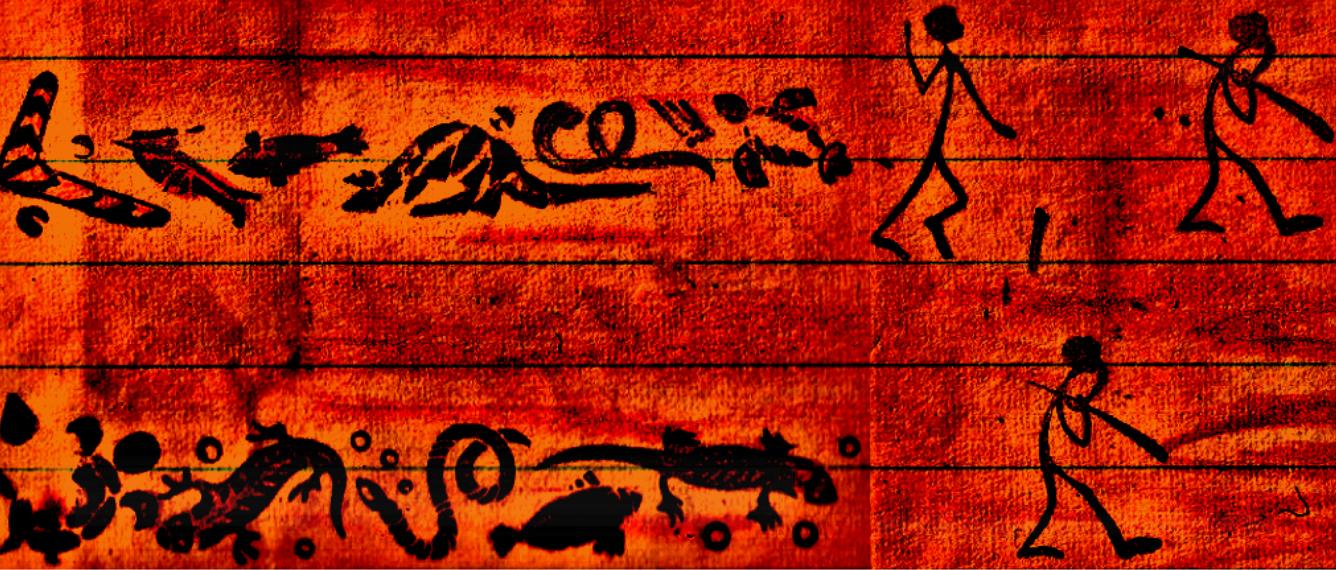
My father’s appropriation used to embarrass me too. A frustrated creative and factory slave six days a week while two of his siblings sold their art, he used his scant spare time to craft things. Once he scored a batch of big industrial lampshades. Upended, necks severed, they made large and small flowerpots, and on them he painted vibrant black-and-white designs with lots of dots and wavy lines against an ochre background. Yet, compared to the art he sought to evoke, his efforts looked as gauche as the photo album cover from which he borrowed: the mix of lizards, fish, a turtle, horned quadrupeds and men with sticks typifies the ad hoc whimsy of the genre.
Speaking of which, the national Aboriginalia appeal invites you to donate your own Aboriginal kitsch. Sort of like an amnesty? As Albert says:
Stirring words, and what a stellar example Albert sets. Yet I have nothing to take to the MCA’s ‘dedicated drop-off station’. That un-PC album holds old photos of my childhood home and garden and the nature strip outside before the road got widened. Which reminds me: Albert isn’t taking this tat out of circulation. Far more folk will see it in public spaces than if it stays with private owners. Granted, he’s transforming its meaning and using art to educate. Even if his audience has got the memo already.
Still, the hope that surrendering potentially offensive objects (many, if not all, of which are schmaltzy, twee and tasteless even before you reject them as racist) could somehow make Oz a more equitable, inclusive place has precedents in ancient ritual sacrifice. Yet the question of whether to donate your paintings of warriors on black velvet etc. or keep them because they’re antiques you might one day wish to sell isn’t just about white guilt (a bottomless well) but left vs. right ideology. Hence, the structure of the debate is familiar.
For a recent instance, take the controversy over Covid shots. One side might think salvation lies in relinquishment – of racist relics or bodily autonomy. The former can contaminate minds; vaccine refusal can mean disease. And scientific proof can be produced to back this view or, depending on the research bias, refute it. Yet to the opposing side, disowning dubious keepsakes or rolling up your sleeve might appear merely performative. Self-responsibility might seem safer than pious herd conformity.
Of course, if you resonate with Albert’s project, the scope of which has only grown and which deserves ever more exposure, it makes sense to give him your knickknacks. Not like the souvenir industry employs enough local Indigenous folk that inauthentic wares could soon go extinct, but reserves of the vintage kitsch that lends Albert’s art retro charm are dwindling. And in publicity for his show, such pieces have been upstaged by crowd-pleasers like a video of him singing a Miley Cyrus song off-key while swinging to and fro naked on an exercise ball, shattering representations of Captain Cook statues. Yet You Wreck Me (2020) just feels tame. Activists with the balls to topple monuments face steep fines or jail.
Which reminds me… Aside from traditional art with all its mystique, some of the most potent Indigenous works I’ve seen open a window on the lives of the prison inmates who paint them. Albert, for all his visibility, doesn’t depict his personal world. We don’t see his studio assistants. Instead, he holds up a mirror. And while some may recognise their own guilt in the reflection, others will hit a wall of words they’ve heard from elite institutions repeatedly.
Still, Albert’s show inspired a trash and treasure hunt. Hence I found old schoolbooks stamped with Aboriginal motifs by bigoted teachers trained to spread ignorance. And my father, an ex-stockman and WWII vet, had owned a battered army bushcraft manual, Living Off the Land, full of tips gleaned from the original inhabitants. Its last chapter, ‘HOW TO KNOW THE NATIVES’, demystifies ‘No. 1: THE ABO’ and ‘No. 2: THE FUZZY WUZZY’, e.g.:
Note the irony. For too long, all of our institutions – cultural, educational, military etc. – have perpetuated lies or, at best, illusions. Yet in recent decades the tide has turned. More often, more institutions promote inclusiveness and the arts lead the way. Yet institutionalisation isn’t a neutral process that just needs to get on the right side of history. Like the digital technology that extends its reach, a reciprocal arrangement, at heart it’s antithetical to art, love and nature.


A huge topic! Politics has infiltrated everything! But it’s not even politics anymore, its toddler sandpit play or at most high school playground, with money, power and weapons of mass destruction as the toys. True politics involves intelligence and agency and creative cooperation, not any qualities you see in any government anymore. True politics knows its right time and right place not like the pathological quagmire that infiltrates everything as an entitlement.
Thanks for the tip into Tony Alberts work.
Thanks for your thought-provoking response. I hadn’t thought of politics as a single thing (even if I had the patience to stay w/ one topic 🤣). From my necessarily biased perspective, the infiltrator looks less like politics per se & more like digital tech, which profits massively from the politicisation of everything, including subtle aspects of existence that don’t translate well, if at all, to online/binary simplification. I think of politics more as a layer of reality that was present all along but now lies exposed, like the strings moving puppets when the lights come up, but also as a function of complexity resulting from population size & density. Hunter-gatherers thrived w/o it for millennia. 😁
…like Pluto going through Capricorn purged the societal toxins to the surface for us all to see and unfortunately experience!
So, now Pluto’s in Aquarius, we can look forward to tectonic shifts in politics?
…watch this space