– Russell Marks (paraphrasing Marshall McLuhan)
Where all is present to the solicitations of the eye, nothing can materialize as meaningful.
– Antón Barba-Kay
Some time ago, I spoke with a local photo printer and framer about doing a photo monograph. He said a print-on-demand publishing platform was the best option if I could supply a print-ready file, and offered to convert the colour profile for free. But when I returned, his assistant said he’d taken a sickie and was too busy, tried to address my issues without listening, and asked what editing program I use. ‘I don’t edit my photos,’ I said. So this motormouth apprentice deemed me clueless. The thing to avoid, he warned, was pixelation. ‘Do you know what a pixel is?’ he asked. ‘Pixels are those little square—’ ‘I know what pixels are,’ I cut in.
Back to square one. I ordered a proof copy of my book, unconverted. And when it arrived, the colour looked fine. So much for the printer’s opinion. Lucky he hadn’t seen my shots in all their unedited glory; he might’ve judged my work unfinished. Too raw. But his patronising minion had got me thinking about the left-brain bias of the technical mindset; its blindness to the big picture combined with low-stakes demands that photos etc. must meet superhuman standards of precision, as if perfect focus were the ultimate measure of aesthetic pleasure.
Is the widespread notion that edges of objects in photos must be sharply defined a cause or an effect of the reign of Big Tech and the enforcement of its values on the texture of our reality? Because surely everyone and his/her/their dog knows what pixels are, more or less: discrete elements constituting digital illusions on screens, as our world proceeds to atomise into separate units, from binary bits, bytes, blocks etc. comprising digital data – the means by which communications pass between humans and, far more, machines – to the numberless if numbered boxes we call homes, shops, gyms or offices.
When I showed the prototype of my photo monograph to a friend whose hobbies include photography, he thumbed through it tut-tutting. Fair enough – I don’t seek to please precision freaks. I’d rather smear paint on a canvas with rags or my bare hands than make hard-edged marks for their own sake. Exploring and exploiting the contrast between hard and soft is more fun, and also gives the brain of the artist – and the viewer – more to do.
Anyway, my friend showed me some of his shots too. But zooming in on details, extolling megapixels and lenses, he gave me no time to absorb each image, let alone respond. Maybe he felt self-conscious? Yet this sort of habitual haste is ubiquitous. Constant societal pressure to produce and consume with no room for rest or reflection, as if urban life were one massive factory farm, has trapped us all in a cycle of escalating harms. And the ultimate upshot of our manic consumption of whatever can be monetised – a fast-expanding array – is psychic indigestion, individually and collectively, ergo the rise of AI: species-wide gastric reflux.
Because despite our growing isolation amid ever more ‘connection’, a malady that too few seem to recognise, our self-protective mechanisms can’t adapt fast enough to the incursions of corporate ‘innovation’, hence the increasing prevalence of autism, ADHD, autoimmune diseases, depression, anxiety, dementia, obesity, poverty, homelessness, debt etc. The system imposes selective controls to keep the masses in check; distracts us with toys and games that maim our imaginations, tools that don’t make us more creative but just beget uniformity. Witness AI-generated tracks by virtual artists now topping charts that used to feature music. Or let AI remove unwanted objects from your snapshots to get an end result uncannily divorced from reality: neat, tidy, generic, unchallenging, sterile, forgettable, fake.
I first saw what photos could be in my teens: more than mere records or mementos. A photographer was an artist with a vision as distinctive as any painter, sculptor or filmmaker. Photography was a calling, not just a job. And in the late ’70s it called me, but the noise of competing voices and my doubts drowned it out. Admittedly, I never quite quit. But unique perspectives remain unseen until realised in an apt medium. Often, the best shots show us what we already know, but in a new way. Microscopes and telescopes, too, can expose what the eye misses, but as a function of technology, not creativity. And yet, unlike the wonders seen through an electron microscope, successive magnifications of a digital photo depict disintegration into featureless segments. While the former can penetrate the surface of matter, the latter strips reality of all depth.
Yet no lens, however refined, can reveal the locus of the soul or the presence of spirit. Technology is blind. At least since the Enlightenment, the West has sought to abolish mystery, debunk ‘myths’ and ‘superstition’, and elevate scientism. Hence, nothing now means more than money, said to make the world go round yet flattening it (if not into a level playing field) until texting, email and social media yield all the token contact we need.
And so no local sunrise, moonrise or photogenic cloud escapes a small crowd of passers-by pointing their phones at the sky and shooting like hunters during open season, compelled to capture the specialness by taking mostly identical snaps to upload to Insta or Facebook – all seeing more or less the same thing and sharing more or less the same reflex; focused on the fleeting beauty, not the litter they leave.
The original meaning of the word digit – from the Latin digitus – was finger or toe, or a finger’s breadth used as a unit of linear measurement. Ironic, then, that a word referring to part of the human body has since come to mean a symbol sometimes inimical to the physical. Compare the word analogue, meaning likeness. Or, for instance, an image of something resembling something else, like a close-up view of the surface of skin, hair, bone, a shell or stone reminiscent of the Earth seen from above. Similarly, analogue technologies retain a more direct relationship with embodied knowledge or sensation than do their digital substitutes, which proceed from and lead to abstraction; the difference between waves on the one hand and binaries on the other. Or between the vibrant rainbow spanning the sky outside my window and a mass-produced Dulux colour wheel.
Which reminds me… Employing the term spectrum in the diagnosis of certain disorders not only widens the net but serves to medicalise or pathologise numerous character traits that aren’t ideally adapted to a world that worships the gods of efficiency, comfort, safety and rationality. But hey, as the ranks of the disabled swell, our newly solicitous culture is starting to make a few adjustments in public places: noise reduction, softer lighting, less visual discord, quiet zones. As if to more closely evoke the natural world we’ve disowned.


…Alleluia to the quiet zones! If only we could go back in time and understand more deeply what ‘digital’ would kill. Your digital/analogue comparison is so interesting and feels so true. I hadn’t computed (pun intended😉) that the word digital comes from digits )fingers and toes.
I have seen your photos and it doesn’t surprise me that those who doesn’t have an appreciation of the creative spirit and art to perceive the intense beauty in them. All though you are engaging in photography, to call the pictures photos does them an intense injustice. Yours are imbued with the unnamable life force that so many photos (even ‘famous’ ones) are missing. They are ‘of themselves’ and organic, it is obvious you have been a conduit for that essence of time in its absolute fullness.
It’s bizarre, isn’t it? Like, neurotypicals thrive in violently noisy, fluoro-lit, foul-smelling, crowded settings? Let’s pretend such settings are valid & normal unless you have a disorder. This culture is so dishonest, it’s crazy-making! 😀
Thanks for your generous assessment of my work! It makes me think of how I’ve felt in the presence of genuine outsider art (old examples; if there are any real outsider artists around these days, we can bet we’re not ever going to get to hear about them). Such images have electrified me w/ their immediacy, their psychic/emotional intensity, & yet someone else might just see quaint scribbles or doodles.
Which makes me think that art training, once undergone, functions as a kind of filter; as if the artworks appear to the viewer at one remove, making them somehow safe or accessible or relatable. And yet, I think some artists remain outsiders on an inner level. Van Gogh took classes but it didn’t tame him.
Oh god yes so bizarre. I think we know where the disorder lies and its not with the ’sensitive’ ones …
🤣
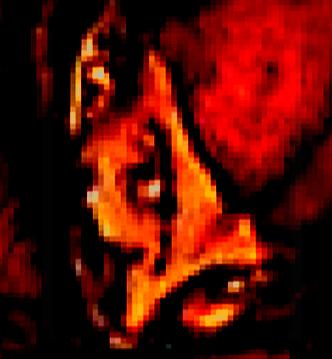
Ps I love the pixel picture. The colours called me immediately.
Pps: sorry my grammar in that first reply is appalling 🫣
What are you, an outsider writer? 😉