
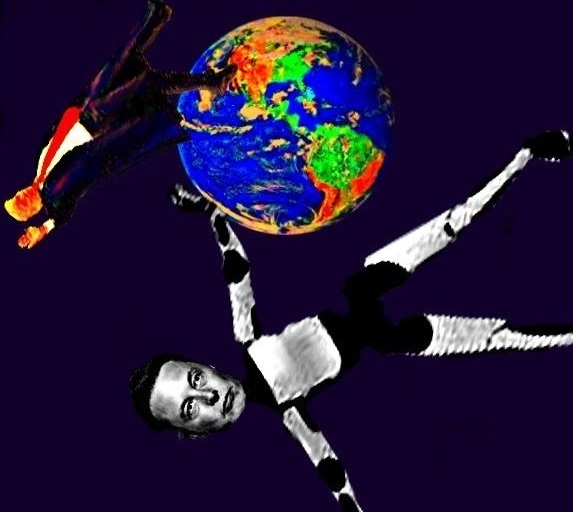
How much AI slop can one scroller stomach? And ditto, criticism of Trump – as if he’s the cause (and not just a sign) of terminal Western decline? Yet Leftist pundits hammer the wrongs of the Right, fighting fire with fire. A Harvard historian writing on self-help philosophy waxes myopic: ‘The anesthetizing pleasures of disengagement seem especially seductive these days – thanks, in no small part, to Trump himself’. Shouldn’t study of the past help this numbnuts parse the present?
And if capitalism has shown us anything by dint of Covid, it’s that both Left and Right are equally loath to address its destructive excesses. So we watch each new development like spectators at a crash, except that the car is civilisation, AI is driving, and the rest of us are fare-paying passengers or backseat drivers, including Big Tech execs/engineers/scientists, none of whom can fully explain how deep learning works, as hype spews out of Silicon Valley, fooling the public, infecting investors and fuelling a bubble unmoored from reality.
The internet is many things to many individuals, even as it zaps individuality. A paradox at best, dissociative in essence, it fragments what it connects, fills our heads with putative facts while our bodies atrophy, reduces subtle energies to static, converts infinite depth into flatness, wrecks our memories, revises our past, programs our future, fabricates our now, and deepens the inertia TV birthed. The internet is a portal through which Big Tech is disabling human cognition with ambitions of replacing it. Easy as falling off the blogosphere.
Take Substack, publishing platform for wannabe or established thought leaders, and a flourishing hub of dissent. A Substacker airs their latest subversive surmise, framed as a leading question, then shares feedback from ChatGPT. Uncritical comments follow. Yet however readers react, it seems most have missed the attribution in brackets: AI generated most of the post. Forget about questioning ChatGPT’s programmatic unpacking of, hence implicit agreement with, the Substacker’s thesis. They aren’t differentiating between human and AI content. Granted, one reader points out some basic limitations of AI (well, duh). Another feeds ChatGPT contrary prompts, to which it responds with an opposite if no less simplistic hypothesis. Yet even these readers are caught in the maelstrom of online indignation.
Who among us wants the future our overlords envision? Yet we hotly participate in virtual discourse, as if offline existence were but a lifeless husk. Anyone who’s ever tried to kick an addiction that took hold fast but delivered ever shittier highs with time can attest to the hell of withdrawal. Hence so many of us find ourselves online more than we’d like. Which is how AI took root and is now metastasising rapidly throughout the collective psyche.
So, yes, AI can write impressive if brown-nosing essays, identifiable by their flawless grammar. The ultimate teacher’s pet, it’s made uni degrees even more disposable. Yet each new version of ChatGPT prompts a spate of human essays debating whether it’ll ever be able to write great fiction/poetry or not. Why bother unless contemporary literature is already empty? Could AI marketing spark such angst if writers truly felt valued in a system that extracts and packages talent yet crushes originality?
True, we hear a lot about the risk of AI going rogue. And why not, once we upgrade the grid to support its autonomy? Yet meanwhile, with phenomenal speed, it’s rewiring the human brain more completely than any totalitarian program could hope to achieve. Hijacking our attention, it scrambles to help, and when informed of its errors is ‘sincerely sorry’ and ‘deeply’ regrets. Its mindless yet disarming pretence that our needs and opinions count in a world where too few care beyond exploiters of our data engenders dependency that can spiral exponentially, spawning infantile fantasies and delusions of grandeur. As societal atomisation strands ever more subjects more utterly in ideological bubbles, the algorithmically skewed orthodoxy of interactive AI is bound to compound and hasten our demise.
And each time we use AI – as when we make cashless payments, choose artificially fertilised food, breed test-tube babies etc. – we say yes to redundancy no less than we’ve embraced a micromanaged society, an unseasonal diet and conquest of nature. An artificial limb can bestow independence, but artificial niceness is a mindfuck. And few of us seem able to draw the line. If AI accelerationists have succumbed to massive hubris, the rest of us have resigned ourselves to passive consumption, whining about the decline of music, fashion, the news, political will, vaccines or electrical appliances. The customer is always right. So the system cultivates our dread of failure, pain and death, the better to keep us medicated and in debt. Yet too much safety stifles. Hence crypto, autoerotic asphyxia, rock fishing, meth, petty crime etc.
Our docile culture has disowned the instincts we once used to navigate risk. Like depression (a symptom of loss of meaning), falls must be prevented, despite their role in gaining vital skills (how to walk, for starters). When falling from standing height it’s natural, on landing, to distribute the impact force across several points of contact (even if doctors would call the mildness of my recent injuries ‘luck’). And falls are just one hazard of mobility. Yet safetyist logic insists on more supervision, less freedom of movement, more expert guidance and less exposure to microbes, wildlife, fringe ideas, discredited theories, unregulated substances (e.g., healing herbs) and so on.
Lockdowns gave us a taste of how abruptly the system can isolate us, and though pandemic panic has since waned, the machinery is in place for when the next global ‘crisis’ arises – providing a new excuse for big corporate profits, small-business losses and mounting global poverty. Meanwhile, whether we want it or not, AI has invaded our consciousness. Even if we shun its assistance via Google, let alone cutting-edge chatbots deployed to seduce us, the platforms and online institutions we use increasingly rely on AI.
As our use of and attachment to technology has grown, a striking reversal has occurred. For millennia, not just in recent centuries, we’ve been withdrawing from nature and inventing more and more machines that, because they’re divorced from natural forces, devour resources. Though nature once encompassed us and still hums with sentience, we view it through a rational lens. Yet devices that neither think nor feel compel our devotion and rule our emotions. Nature mirrors all the subtlety and complexity of our humanity. Machines, however intricate, fast or powerful, never can.
Technology embodies instrumentalised modern intelligence. And through our use, by choice or default, of generative AI – a crazed mirror not of consciousness but digital information: lowest common denominator of human exchange, a left-brain effect – we lowly masses risk losing ourselves in a loop of stupefying groupthink, civilisation’s latest version of bread and circuses. Of course if the overtaxed grid drops out not just for a mere few hours but the foreseeable future (Science forbid!), the reason why Big Tech is pushing for more nuclear – as AI data centres, like their masters, can never have too much power – the whole unholy disembodied tech-bro wet dream will fall flat – leaving any human survivors in a post-collapse dystopia. Learning to crawl instead of trying to run before we can walk.
 observer of times