
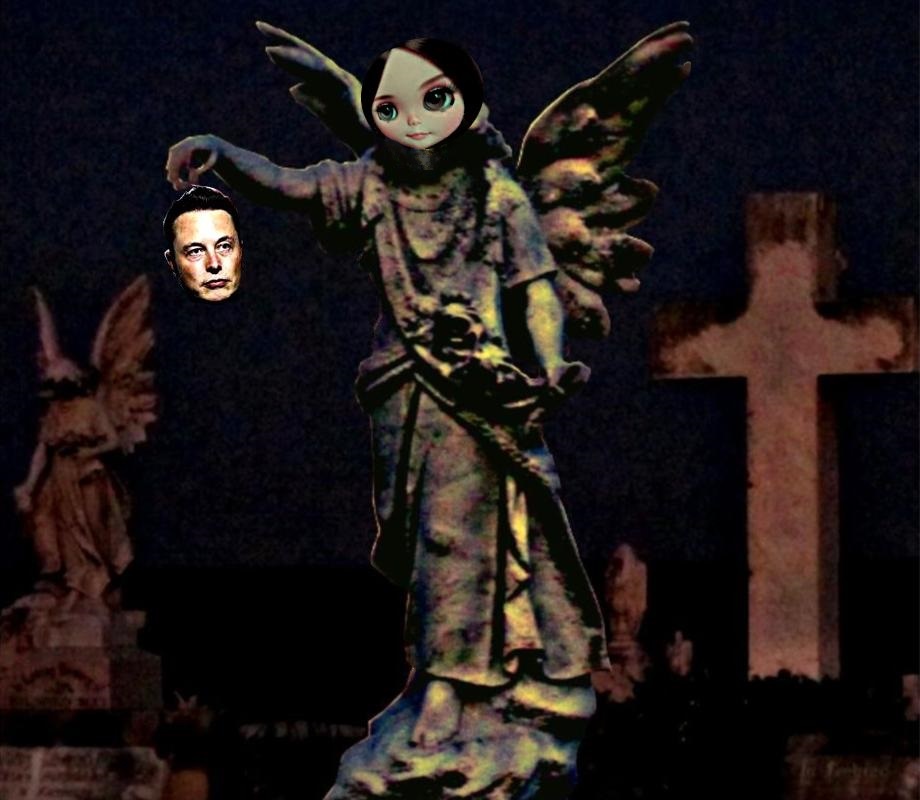
Lately I’ve begun to explore the local graveyard at sunset. Its mazy paths and sea views soothe me as I dodge the death-phobic hordes. No tours of famous graves run at dusk, most joggers haunt the grounds at dawn, and birds abound as the sun goes down. Aside from their calls and planes droning, the site is blissfully quiet. Do all those engraved appeals for eternal peace, love and rest actually exert an effect? Even if it sucks that the bones of the entitled dead rate more real estate than the underprivileged living, I feel blessed to see trees and angels, not high-rises, on the skyline and a vault of stars undimmed by misspent electricity.
We are stardust, Joni Mitchell wrote back in ’69. Billion year old carbon / We are golden / Caught in the devil’s bargain / And we’ve got to get ourselves / Back to the garden. More than an anti-war lament, ‘Woodstock’ still resonates, with light pollution obscuring the stars, the devil gaining ever more traction, and Eden fast receding beyond our imaginative reach. Meanwhile, the rise of high tech has screwed original music, unleashing fancy tools on the clueless, and jaded audiences opt to listen for free, denying serious artists the income they once received. Seems too few folk today give a fuck about trying to get their souls free.
Recently, in Sydney’s botanic gardens, I saw a sign displaying a photo of Lady Gaga, after whom, the text informed me, 19 ferns have been named, an honour once reserved mostly for botanists. But boundaries are breaking down. And information is swamping social space. Public parks, like cemeteries, used to offer refuge: serene green oases amid urban desert. And, to some extent, they still do, as habitat for diverse mammals and birds and diversion for humans. Yet the profit motive never sleeps, encroaching through informational creep. And the noise of factoids drowns out our subtle inner voices – instincts, memory, intuition, reason. Imperialist by nature, informational logic treats the human mind as an empty wasteland to be ploughed for the planting of cravings that serve corporations.
And yet some folk still tell themselves technology is just a tool, a value-neutral means to an end: digital media made to control us can be repurposed to subvert the global capitalist machine. Because content is what counts, and ours counters the dominant narrative. Or so many dissenters believe, unaware that, to Big Tech, it’s all just data. If, as Marshall McLuhan said, the medium is the message, it’s syntax, not semantics, that signifies. So all information traversing the net, syntactically, holds the same status, regardless of search engine rankings or paid subscriptions. So as we disperse ever more words and images online, sharing know-how, showing off, socialising, selling something, building a profile, soliciting funds and/or seeking subscribers, we turn ourselves inside out and interiority dies.
Speaking of which… A gross new satirical film, Coralie Fargeat’s The Substance, whether by accident or design, neatly depicts the split that afflicts the modern psyche. Sacked by an ageist producer, a TV-host heroine impulsively does a deal with the devil. And when a black-market injectable frees a young self from her dated shell, like Cinderella at the ball, that ideal self is an instant success. But the control-obsessed old self and the hubristic new self can’t accept their interdependence. So disrespect for limits destroys them both.
And a similar failure to recognise, let alone respect, limits is the defining tendency of our age. As the speed and volume of verbal and textual traffic has grown, making information not just more available but hard to avoid, we’ve lost the ability to filter out idle noise. The dual selves of the protagonist in The Substance must alternate between public and private, an outer life and downtime, if they want the serum to do the trick, or even just not to kill them. But no: a grotesque fight to the death comes more readily than give and take. And this is the plight of humans today, warring over resources. Like the ageing celeb in The Substance, most of us stay on the surface. With the words depth and death separated by one letter, our metaphors for going deep include rock bottom, the pits, lowest ebb – even if a receding tide can expose sand strewn with treasures.
‘Respect the balance,’ says the unseen substance supplier. But any semblance of mutual respect between the two selves is soon lost. And this lack of empathy, which degenerates into enmity, exemplifies our self-defeating ethos. We aren’t taught to love ourselves unconditionally – quite the reverse. And unless we embrace our own inner contradictions, we can’t face and befriend them in the outer world. That the contradictory selves in The Substance are female is a pity, though, if only because most critics have stressed the political over psychology – a film attacking superficial values has sparked surface-level analysis. (Not sayin’ endemic misogyny should go unchallenged… Even if satire in our crass culture is hard to distinguish from reality.)
But our information economy – or lack thereof – works against balance. If we register just a fleeting hint of interest online, the Big Tech leviathan plies us with yet more enticements (‘you might also like’ or ‘frequently bought together’). It doesn’t care whether or not what we read or listen to benefits us as long as we continue to fall in with its growth-crazed agendas. Or we get heavy government messaging designed to compel compliance. So the information gluttony imposed on our culture, like force-feeding of geese to prepare their livers for pate, is a far cry from balance, and the ranks of the obese, depressed, demented etc. keep on increasing.
And this overexposure to info – the lifeblood of AI (trained on input of mixed quality, which makes it a dodgy god) – has rewired many of our brains to such an extent that some humans anticipate AI becoming sentient, even as they fail to compute that the creatures they eat feel real, not feigned, pain. We are, it seems, supremely susceptible to brainwashing; it’s all too easy for some of us to forget (if we ever knew) how much our consciousness, such as it is, derives from our gut microbiome, an ancient source of wisdom that Big Pharma is busily killing. And to the extent it succeeds, we find humans prone to assume AI knows best: a magical toy created by grown-up boys remote from nature.
To hark back to Fargeat’s fable, the maintenance packs for serum customers and their doubles bear the labels ‘matrix’ and ‘other self’. And our home planet, which has become somewhat the worse for wear of late, finds an apt analogue in the trials of the ‘matrix’, while the ‘other self’ – emerging from the matrix at great cost to her health – is an ideal analogy for our technological urges. Yet, like AI has shown it can do at the drop of a hat, she runs amok until the ultimate result proves more repulsive than the ordinary ageing process demonised by our culture.
The supposed apotheosis of informational civilisation, AI also epitomises its risks and constraints. Yet over the centuries, facts have been instrumental in axing divinity and hacking a godless hole in the collective soul. A friend of mine, an atheist new ager, believes AI is destined for sentience. Read enough essays or books by AI evangelists (Kurzweil et al) and you, too, could wind up confused. Beguiled by information into sharing more than they can read, this friend awaits the singularity like a Christian expecting the Second Coming. That many atheists anticipate the exponential development of omniscient artificial intelligence may suggest that suppressing the religious urge innate to humanity only results in its displacement.
 observer of times
Yep…and thank you for reminding me to check whether I had ‘opted out’ from Linkedin using me to train its AI. The downside in ‘opting out’ is that AI is trained by those who remain ‘opted in’ and if the conservatives and fundamentalists of all kinds, who want a world reflecting only them, remain ‘in’ AI will continue to train us to think like them/it. A-g-g-h.
Your comment raises such interesting & complex questions! I think it’s fair to assume that anything & everything any of us posts online is AI training fodder, unless we get asked if we want to ‘opt out’. Though nothing I’ve posted has ever drawn much human traffic, spambots don’t discriminate. Nor does AI. Why bother when each new iteration is faster? Easier just to scrape every inch of the net for data. Which doesn’t mean opt-out clauses aren’t token. Or that the horse hasn’t already bolted. So it’s probably naive to think we can really opt out if we use the net at all. What strikes me as much more important is to be awake to the ways that information we encounter online, an exponentially growing proportion of which is AI-generated, is geared to manipulate or condition us. But, looking around me, it’s hard not to fear that, w/ a very small proportion of exceptions, that horse has already bolted too.