
And out of the grind the LOUD Gov farmed every butt of the failed, and every fool of the air, and brought them unto Adman to see what he would call them: and whatsoever Adman called every living creature, that was the name thereof. Person with ADHD, he called them. Person with ADD, ASD, SAD, OCD, BPD, NPD… And many felt relief to have a name for their experience; felt less alone knowing others experienced the same.
Scoliosis is easy to diagnose. Anyone can see it. (Like the batshit stranger who waylays me at the pool and spouts details of her own treatment.) And over time, despite corrective surgery in my teens, my spinal curve has visibly worsened: a lateral (and literal) S compounded by three-level rotation. I noticed about ten years ago that my torso looked more crooked than in the last pre-op X-rays. But my quest for help got shelved as my 90-something mother wilfully waived all self-responsibility. Such challenges as a fractured knee when a car hit me, a surf injury, coordinating my mother’s carers and keeping her out of hospital, finding her a nice nursing home and selling her house to pay the deposit amid chronic sleep loss (demonic neighbours) distracted me. Yet my gut had begun to jut out though I hadn’t gained weight, and my clothes didn’t hang straight. Then my mother’s funeral video showed a budding hunchback. So each month now, my physio measures me and we tweak my stretches.
Compared to an observable curvature, disorders described in the DSM-5 are hard to diagnose. I can’t see, say, ADHD in a stranger. Nor in a close acquaintance who claims to have it. We’ve shared many exchanges and I find her spontaneous, yet not unduly unfocused or hyper. How did she know? She read a book about it. But I’m not so sure. The symptoms she named just sound like traits at odds with oppressive cultural norms. Yet she’s more attached than I am to the pay-offs for playing the game. The thought of taking a pill for it appealed to her. But, I said, what about side effects? We don’t always see I to I; she prefers the sound of her own voice to mine. And her kind tend to embrace, if not condone, the dominant culture, which spews quick fixes, quick quizzes and fads: DNA test kits from ancestry.com, star-sign columns, ‘Are you a narcissist?’ articles. If the profile fits, just click on the nearest ad.
And as we do, capitalism works not just on but in and through us, ceaselessly surveilling, quantifying, analysing, labelling and codifying all our behaviours, problematising difference or irregularities, ramping up stress by prompting comparison, ergo competition, while simultaneously training us to monitor ourselves, then, when we fall short, selling us products and services geared to promote dependency, off which corporations profit. And since none of these treatments can remedy the emptiness of an essentially manufactured vacuum, most of us stay on the treadmill of craving: passive consumers waiting for the next text, call, update or new release, looking forward to weekends, study breaks, annual leave, Christmas, New Year’s Eve, Valentine’s, Easter, EOFY sales, Halloween, birthdays, anniversaries, civic festivities, happy hour, happy endings, tax refunds and dividends; anticipating each vaccination, test result, regular check-up or token changing of the guard that simulates democratic election.
Tokens in every possible form have become the mainstay of our culture. In the progressive absence of direct connection, we trade commercially made and marketed symbols of affection. Our memories look increasingly like photos and videos. We pay lip service to intimacy while incessantly caressing devices. And as we value tokens, we devalue lived reality. When I google ‘are we living’, the top autocomplete option reads:
are we living in a simulation
Why ask? What difference does it make if we’re all going to hell in a handcart and have been for decades, during which our strip-mined, deforested, monocropped, toxified, hottening planet has only gained momentum on its downhill trajectory? As warning signs and tipping points whizz by, we stand divided. The mainstream media suggests the AI con will be offset by the pros of a utopian, virtual, post-human future in which robots + nanotech replace nature, autonomy and embodiment. Meanwhile, dissident prophets preach prepping for a dystopian epoch of epic shortages, power outages, overgrown ruins, nomadic resurgence and retreat to low-tech rural communities, viewing AI as a mere dead end, not the dawn of Armageddon. Readers of media captured by multibillionaire donors bank on the promise of high-tech solutions to mind-blowing problems; if humans alone or combined can’t find answers, maybe AI can. So they lap up the Kool-Aid and hope the unholy alliance of state and corporate power that gave us an overstated pandemic and an understated recession will save them.
Kudos to those who dare to divest from the corporate-capitalist nexus, return to the land and grow their own food. But many more Westerners want the best of both worlds; they drive big hybrids, fly to secluded retreats, eat imported organics and overuse renewables as oil and gas deplete. And we all enact contradictions, consciously or not – reviling societal evils while tamely enabling them because we lack the time, skills, guts, means or will to push back.
Carl Jung, father of archetypal psychology, who derived some key insights from astrology, recognised that moments in time have a quality. Each is unique despite cyclic recurrence of themes. And this quality of time, revealed through history (a forest is hard to see from among the trees), manifests independently of petty human doings. The idea that we went wrong with agriculture/monotheism/industrialisation is nonsense, if only because collective drives aren’t conscious. Yet the ego demonises unwelcome developments (threats to cherished or useful species like butterflies and bees, destruction of ancient sacred sites by mining etc.) – anything with which the ego identifies. And that which the ego deems other, it rejects – blind to endless and varied connections that inextricably bind what it wants to what it dreads.
Where do I stand? Mostly left or right of centre; depends on which vertebra you sight. But for me, nature taking its course meant a descent into disability. Contra feedback from some physios, intervention is needed. Yet my body resists my attempts to untwist with muscular pain, boredom fogs my brain, and when progress slows or reverses I feel regret that I delayed finding help and, far worse, acquiesced to surgery.
It’s a micro analogy of the broader reality. For me to see the mechanistic fix of a titanium implant as a wrong turn in my journey is akin to ruing the invention of computers. At the time, the op that redefined my future seemed simple. Yet implications continue to proliferate. And others in my shoes might choose the path of least resistance: to vacate their screwed-up bodies, withdraw to their heads, and go with the flow of a system bent on imprisoning us in the net. Why make waves if all paths end at death?
But intelligence doesn’t reside only in the mind. Hence our sedentary society has lost perspective. And our world keeps hurtling further out of balance (at least in my view; I’m skewed too). But when was the world ever in balance? Isn’t existence rather always passing from one phase to the next? The stage we’ve reached in this digital age manifests through labels, logos, avatars, icons, emoticons, hashtags, tattoos, bonus points, carbon credits, gift cards, QR codes, certificates, petitions and countless other tokens, and to deny it is to dissociate. We can exploit or cringe at, adapt to or fight it, but we can’t exist outside of it.
 observer of times
Trying again as I used the ‘wrong’ email. Delete one if it’s come up twice.
Always carry this fantasy of a place in balance and with ‘nature’. Went back to rural NSW for a day recently to where many generations of family lived and are buried and which is one of my ‘fantasy places’. I carry it because of childhood memories of having a fantastic time and a sense of freedom there…and I love the surrounding hills and sense of space. Still love it…but could I live there? Would I fit in to such a community and would I end up being comfortable in the sort of situation in which I would have to live as an aging person? Yesterday drove out around Western Sydney searching for places for a photo shoot to give a visual break in something I’m writing. When I lived up the Mountains and used to travel back and forward to Sydney every day or so my spirit would begin to lift shortly after passing Parramatta going west…no longer. We are certainly building, cementing, ourselves in and it won’t be long before it is a corridor of cement and buildings along the M4, with accompanying tagging. I turned off at what is becoming another metropolis at Penrith with the gladiatorial Panthers arena and, on the opposite side, the club. Eat your heart out Rome. It was a relief to return ‘home’. Yes, it’s in an apartment in the city…yes, there’s another apartment block on each side, but I have created a ‘jungle’ of a garden to look out on to break it and give a sense of ‘life’. I have no answer for myself or anyone else and yes, ‘we can’t exist outside’ what is.
No – only received your comment once, for which thanks. Yes – I too carry that fantasy. For me, I guess it’s a kind of synthesis of the best aspects of the various alternative lifeways I’ve encountered or experienced. In my teens it was artists living & working in the bush in relative solitude. As I got older it looked more like countercultural community, living on the land but w/ greater diversity of skills. Yet always the immediacy of nature & plenty of space; dwellings in harmony w/ & as a response to the environment; mindful use of resources, minimal waste; maximal freedom from inessential technology.
Where in rural NSW did you go, if you wish to say? As a child I was never exposed to ways of living that differed significantly from my parents’ conventional values. School didn’t widen my vision either; I had to retreat into myth & fiction.
The world being built around us now isn’t just hostile to other species but to humans. No wonder so many folk are so physically &/or mentally unwell so often. Surely the sheer ugliness & toxicity of our culture contradicts the delusion of progress. I relate to the relief of, & need for, close contact w/ nature & its beauty, & even the smallest garden soon evolves its own ecosystem as long as the basics of life aren’t denied it.
Mudgee/Wiradjuri country…outside the town along Lawson’s Creek. Family had a farm (grandparents) until my uncle sold it as as he’d inherited it and it became too much to keep an eye on (he’d moved to the city for work once he finished school). We used to go up regularly to check, mend fences, clear weeds (St John’s wart for which you’d be fined if it was found on your property), etc. while others managed it. My dad loved it and wanted to be buried in Mudgee Cemetery ‘overlooking Buckaroo’, which he is. I wrote a version of the story a couple of years ago. You have probably read it, https://andsoitgoes775.wordpress.com/2018/08/12/education-week-the-mudgee-ropes-and-the-lawson-creek-schools/
Ah! Have been reading Tiddas by Anita Heiss, set in Brisbane but the characters are from Mudgee & revisit it.
A fine for allowing a medicinal herb to grow on your property? What if it was under control?
My dad would’ve loved to live in the country, but said my mum ‘wouldn’t have it’.
Somehow missed that post – would’ve remembered those fantastic photos!
Have read Tiddas. Noticed it was turned into a stage play last year. Yes, dad would also have loved to run the farm but mum didn’t want to live there anymore. Her dad died when she was 7 and the family’s world turned upside down…nan was a town girl and wasn’t good at managing it then mum’s brother got sick (I think it was scarlet fever) and they had to move into town soas not to compromise the milk. Anyway the farm was left to mum’s brother so that was the end of it.
Just figured out how I missed your story about Madge, Mudgee etc.: the week you posted it I was focused on trying to get my mum out of a dodgy nursing home (the only one at the time w/ a bed) & into one w/ caring staff & an ethical manager. I look forward to reading about that part of your family history.
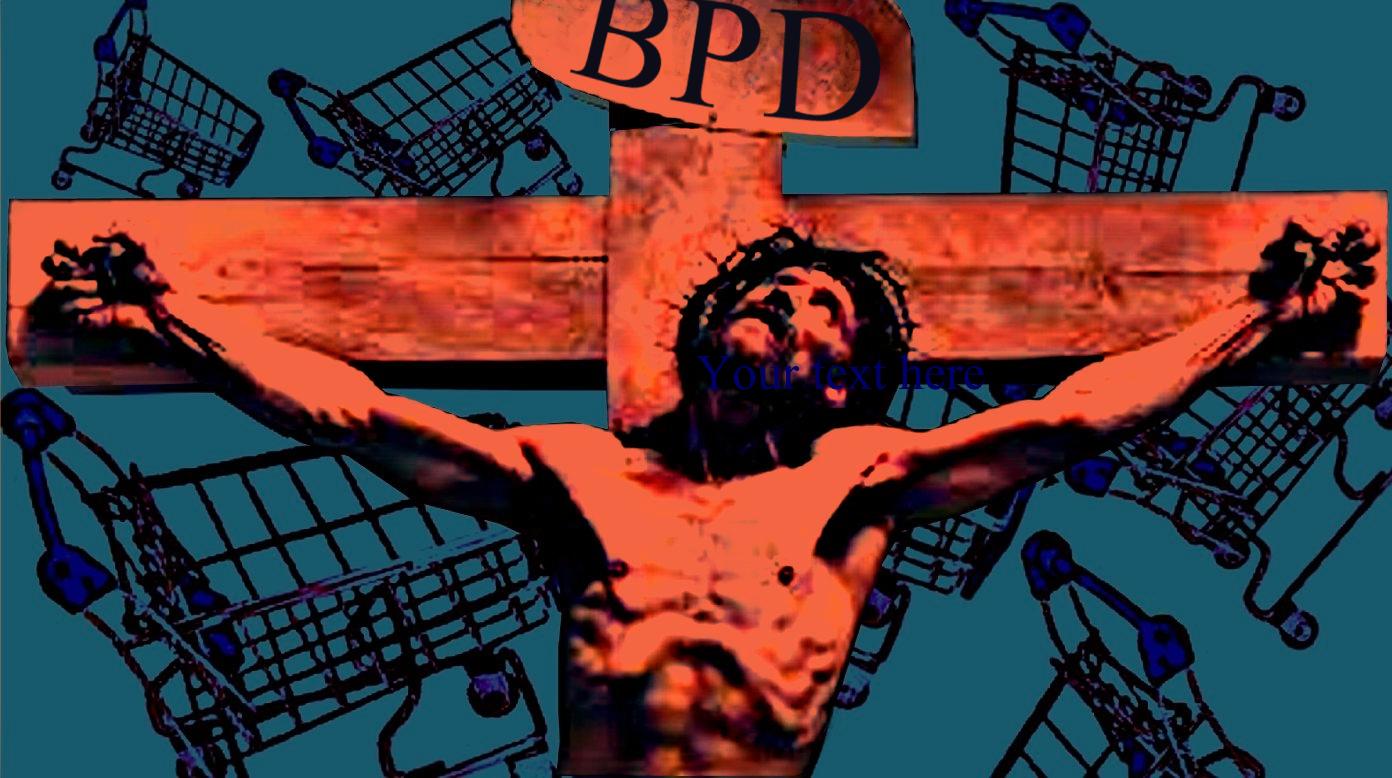
I love the image!
Thanks so much!
At first it was going to be the Earth in a runaway shopping cart. But labelling seems to get to the crux of what our culture does. To label is to put something or someone in a compartment. It numbs; obscures the vast complexity of connections between our traits or behaviours and the factors that spark, enable or entrench them (not to mention the pay-offs). Psychiatric diagnoses function as explanations that short-circuit questions experts can’t answer, because their specialisation is part of our collective insanity.
The idea that Jesus would be seen as insane if he were to return today is cliched but it speaks to context. When the Church held sway over Western civilisation, dissidents consorted w/ the devil or demons possessed them. Now Science is the dominant faith, demons have morphed into disorders. The difference is, these deceptively neat little labels deflect our focus back onto ourselves. And in the echo chamber of feedback from medical experts & media, those thus labelled lose touch w/ the healing potential of subtle energies of the sort found in nature & less repressive cultures.
Yes that image really nailed it. (pun intended 🙂
I personally wouldn’t take such a hard line against diagnosis. I have had a couple of experiences where diagnosis have created a container to allow deep growth, understanding and points of liberation. (But then I do have a Virgo moon which would respond to labels with relief perhaps more than other natives).
The word disorder is particularly gruesome however and as you discuss used to disempower and confuse, and to sow the ground for selling meds etc. Again though, the word works relative to the current cultural order. My experience of dis-order is the challenges occur as a ‘mismatch’ to the expectations of a patriarchal capitalistic colonial order, and can be useful to name in that sense. I have experienced disorder in this context, but don’t attach the word to the primal life force that is sourced from natural law.
Great pun, thanks. 🙂
And especial thanks for providing contrast to my point of view. When I tend (as I do) to write against the cultural grain, nuance can get lost. (Not that the culture holds much space for nuance!) And I’m well aware that many therapists/healers constructively use these loose bundles of symptoms to explore the origins & effects of trauma, & to identify themselves so that those seeking to heal from trauma can find them.
My subjective perspective on the mental health industry derives from the formative experience of ‘psychosis’, which brought me close to suicide & into contact w/ psychiatry & patients who’d gratefully accepted diagnosis & treatment. The effects their meds had on them shocked & scared me, & so instead I found my way via input from Eastern perspectives that read my experiences as imbalances: energy ripe to be explored & harmonised rather than suppressed.
Re the Western perspective, I’ve grown disenchanted even w/ physical diagnoses, some of which have simply been wrong. And bad advice has often followed accurate ones, such as scoliosis, which set me on the path of exploring my body-mind-spirit as levels or systems of interactive energies rather than thinking of it as a self-contained biological entity.
Also, I tend to distinguish between mental health diagnoses that pertain to starkly & generally recognisable behaviours/conditions/states, & those that share symptoms w/ a range of other diagnoses as well as w/ non-pathological character types. Like, someone (e.g. the acquaintance mentioned above) might be self-absorbed w/o having NPD, or averse to doing chores or listening (rather than talking) w/o having ADHD. 🙂
…I would agree re psychosis, I too have witnessed incredible harm, as people I have known to be intelligent, creative, vibrant souls that have been medicated far too quickly and heavily for their perceived psychosis and never returned.
The western medical system is most definitely on a downward trajectory, it was pretty bad before Covid malarky now its worse.
Thanks for your provocation as always
Thanks, as always, for engaging.