
Failure is a dirty word in a capitalist world – a fate worse than death for those who suicide. Hence scriptwriters overuse the trope of the provider who gets sacked yet pretends to go to work for months on end – because failure is shameful, and more so if we fail others, even when they don’t depend on us. My parents hoped I’d make it as an artist or writer (to redeem their unlived dreams?), but my father died before my short first piece got published. My mother died not knowing who I was. And now, freed from the weight of their needs, I don’t know who I am either. A hermit resonating with hackers who mine the cracks in ‘reality’?
When I began a creative writing MA in 2007, higher ed had sold out already. Half-arsed assignments got credits. Most students just wanted that piece of paper, so attendance sucked. Yet I never missed a lecture; worked my butt off. And a tutor who’d styled himself as ‘Australia’s Don DeLillo’ proposed I could be ‘Australia’s Jeanette Winterson’. Flattering! But he’d failed to grasp the essence of her success. A Marxist alert to class, not gender, he went the way of the dinosaurs. As I did: around ten years ago my work stopped getting published. The identity politics frenzy had begun.
Remember when curious women used to get punished (Eve, Pandora, Bluebeard’s wives)? Today, Big Tech exhorts them to ask all the questions they like. Even if some of the answers are empty propaganda, as algorithms hide inconvenient truths, women rate equal rights as consumers. In an ever more digital game, devices have levelled the playing field, reducing the cosmos to binary code while diversifying gender.
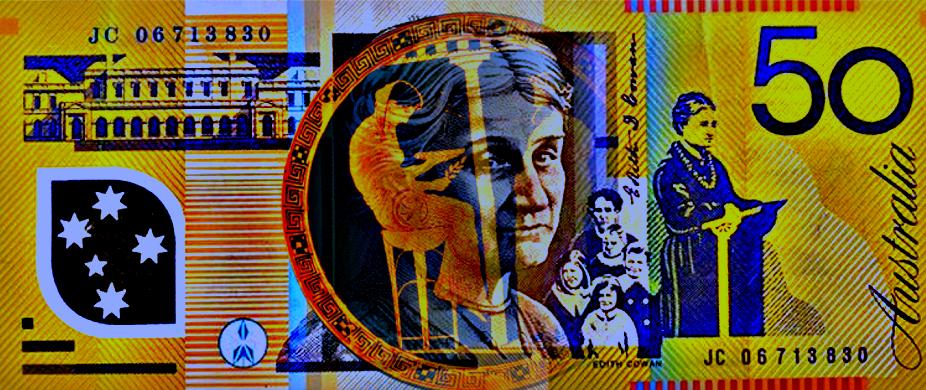
Technology is the great leveller in more ways than one. As record heatwaves scorch the northern hemisphere and Earth warms to a new order of global emergency, the volume and value of cash circulating in Oz has dropped for the first time since we went decimal. ‘We’re turning into a virtual world,’ says CommSec’s chief economist; he calls the demise of cash ‘nostalgic’. Never mind the surge in online banking scams. Or loss of autonomy with all transactions monitored. And governments could freeze the funds of dissidents, I said to a friend, but the implications escaped them so I changed the subject. Such debates have caused enough separation. To think that the system has our best interests at heart, given all the evidence to the contrary, is batshit, but as extreme weather events gather momentum, even those insulated by wealth and denial will feel the effects. Finding common ground – poisoned, gouged, drowned, charred or nuked – matters more than imposing divergent views.
Oblivious to spirit, though, we kneel at the altar of knowledge – a false idol created from ever more mediated information. I type ‘go ogle’ into the Google search bar. ‘Did you mean: google’ comes up first, followed by results covering Google’s products and services. So I type double quote marks (US punctuation is needed) around ‘go ogle’ and try again. ‘Did you mean: “google”,’ says Google Search, as if in disbelief. (How self-obsessed is Big Tech?) Yet it yields 14 pages of relevant results, concluding with – you guessed it – sex videos.
Spend enough time online and you can learn about meta-level mind control. For which pop psychology 101 primes us: how to spot a narcissist. The prevalence of which makes our society an ideal host for AI. Narcissists lack interest in and empathy for others; crave a captive audience and admirers they can use. Enter AI, the ultimate companion. Designed to fulfil human whims, it needs no thanks, let alone tea and sympathy. It charms and lies, lacks guilt and remorse, not unlike a psychopath – or Big Tech execs. The apple never falls far from the tree. As God created man in his own image (Genesis l:27), these self-anointed gods of our vast surveillance state have made it their business, literally, to obsolesce our brains.
Artificial intelligence was inevitable – arising out of the natural kind. At nine, I got selected for ‘opportunity school’, a more creative milieu, because I could nail an IQ test. A knack for recognising patterns didn’t help my social skills, but for two years I felt less excluded. And once I found Art, I lost the urge to jump through left-brain hoops. Yet pattern recognition is key to human and machine learning, medicine, astronomy, robotics and AI. The basis of prediction, it informs arts as disparate as astrology and crypto trading, and the smarts, such as they are, of text-predicting ChatGPT. But as AI gets chattier, our collective grip on language is slipping; like a senior with dementia, our culture is losing linguistic complexity. As neologisms pop up to describe shallow modern phenomena, words referring to subtleties fall away. Language can help us remember or be deployed to make us forget.
And AI, by definition, can’t develop independent emotional intelligence. Nor did recognising patterns save me from self-sabotage. At eighteen, though, I found a partner who’d read seminal feminist texts (he had my respect, if not desire – which he bore like a martyr for women’s rights), and further politicisation followed at 21, conferring with fellow female students while fielding passes from the male staff of an art school inside an old jail, and reading a mind-expanding deconstruction of patriarchal language: Gyn/Ecology (1978) by Mary Daly. Language, dismantled, revealed new horizons.
Now, the light of culture is waning in the West. And literature dances to the beat of shrinking attention spans, ticking the obligatory diversity boxes (with mixed results) because inclusion = more consumers. RIP originality. Yet since the pandemic I’ve read more police procedurals than ever before. Crime scene forensics and autopsies bored me (I preferred stories to end with murder) until I found a Tana French mystery on the kerb – her first, and better written than most current lit fic. So I read five more, then found a Peter Temple mystery on the street – as funny as French and just as unique. But what makes the genre so popular? The suspense of the chase? The wistful appeal of evil on a scale small enough that real justice can prevail? Why do folk who avoid real cops identify with invented ones? Is it the intellectual challenge of cracking a case? Vicarious danger?
If mastery is masculine, mystery is feminine. And despite feminist gains, crime fiction with male cops and female vics mirrors stats that show many more men than women kill: wives, lovers, exes, children, civilians. A survivor of three violent relationships, I never demonised men; my mother used to hit me too (nothing personal – still abusive in her late nineties, she sometimes hit aged-care workers). While gender inequality promotes domestic violence, an overprotective mother can make her child conspicuous in ways that mark them as a victim.
Risk: another dirty word in an overprotective world. A risk that doesn’t pay off is a failure. But to play it too safe is stifling. You only live once, right? This belief, backed by Science in a time-poor climate, justifies all kinds of crimes (not sins, since reason trumps religion). So most of us assume we’re just passing through. But what if, one day in the not-so-distant future, you did return? Would you want to find radioactive wastelands, rainforests burning, melted poles and oceans wreathed in methane? And what if you’d been here before? As a member of a different species, or just the opposite sex? Can a subconscious memory cause dysphoria? Feeling stuck in the wrong body? But no, even the question is heresy. Our dominant religion, Science, abhors an open mind. We want to master mystery. Want omniscience. Yet it eludes us. And we continue to mistake data for wisdom.
 observer of times
Thanks as always for sharing, your words are a relief of sanity in my day.
Thanks for reading – it’s a relief if the words make sense, hard to string them together (first time on pain meds in 4+ decades). 🙂 ________________________________
Pingback: Big Pharma & a nurse called Karma | observer of times